Radiation therapy is part of the standard of care for roughly half of all cancer patients, and new technologies have made significant strides over the years to minimize dose to organs at risk.
Varian’s RapidArc Dynamic solution, available as an optional feature for the latest versions of Eclipse treatment planning software and the TrueBeam radiotherapy delivery platform, is a radical transformation in planning and delivery built to bring extensive treatment flexibility. Powered by next-generation algorithms, this solution combines a dynamic collimator and modulated ports working seamlessly in a single arc treatment field, providing clinicians with supreme control for optimal dose delivery.
Precision in radiation therapy is crucial to managing post-treatment quality of life and reducing the risk of long-term complications as cancer patients are living longer. For example, during treatment for breast or lung cancer, each gray (Gy) – a measure of radiation dose – that reaches the heart increases the relative risk of cardiac morbidity by 5%-7% and increases cardiac mortality by 1%-2%.
RapidArc Dynamic offers advanced precision and control capabilities that have the potential to significantly reduce dose to organs at risk (OARs) while improving efficiency.
Early research conducted by members of the RapidArc Dynamic Consortium – comprising nine leading global research institutions – demonstrates the significant potential of the innovative solution. Results showed clinicians using RapidArc Dynamic were able to reduce plan optimization and dose calculation time by up to 70%. Additionally, early experiences showed that improved dose coverage from dynamic collimator and modulated ports potentially reduced the number of treatment arcs needed by as much as half, while reducing dose to organs at risk by up to 50%.
“RapidArc Dynamic is a transformative change in arc radiotherapy,” said Sasa Mutic, Varian’s President for Radiation Oncology Solutions. “Not only are we increasing the planning and delivery capabilities, we are also decreasing the time and effort needed by clinicians.”
The solution offers several key features designed to give care teams greater freedom and control in treatment planning and delivery.
Improving clinical efficiency
RapidArc Dynamic solution’s next-generation algorithms empower clinicians to plan and deliver treatments more quickly and effectively, managing a high volume of cases without compromising on quality. These optimized algorithms are designed to facilitate faster treatment plan generation and are finely tuned to each machine’s specifications.
This innovative solution enhances workflow efficiency by automating complex processes with built-in tools like Auto-Skin Flash (ASF) and leveraging advanced features such as Multi-Criteria Optimization (MCO), RapidPlan, and clinical goals templates—all seamlessly integrated into the Eclipse treatment planning system.
Ben Archibald-Heeren, Group Manager - Development & Implementation (Med Physics) for Icon Cancer Centre Concord (NSW, Australia), who investigated the use of RapidArc Dynamic on breast cases, said he found “utilizing well-crafted planning templates and the automated flash tool, high-quality plans can be achieved within 3 minutes with a single optimizer run. The optimizer's deterministic nature enables extensive planning automation possibilities.”
Flexibility opens door to more possibilities
RapidArc Dynamic empowers clinicians with features that provide a monumental leap forward in planning and delivery flexibility.
A dynamic collimator enables adjustments in real time to maintain optimal dose delivery, even as the gantry moves, providing maximum control for improved plan quality and target coverage. Additionally, the ability to strategically pause the gantry during an arc rotation provides increased flexibility in dose management, allowing for enhanced dose modulation at key beam angles.
In early cases, consortium members reported the “number of arcs, ports and their angles were adapted to each patient's anatomy to balance target coverage and organs at risk (OAR) sparing. Static angle modulated port were selected to replicate tangent angles to maximize benefit of irradiating the breast alone.”
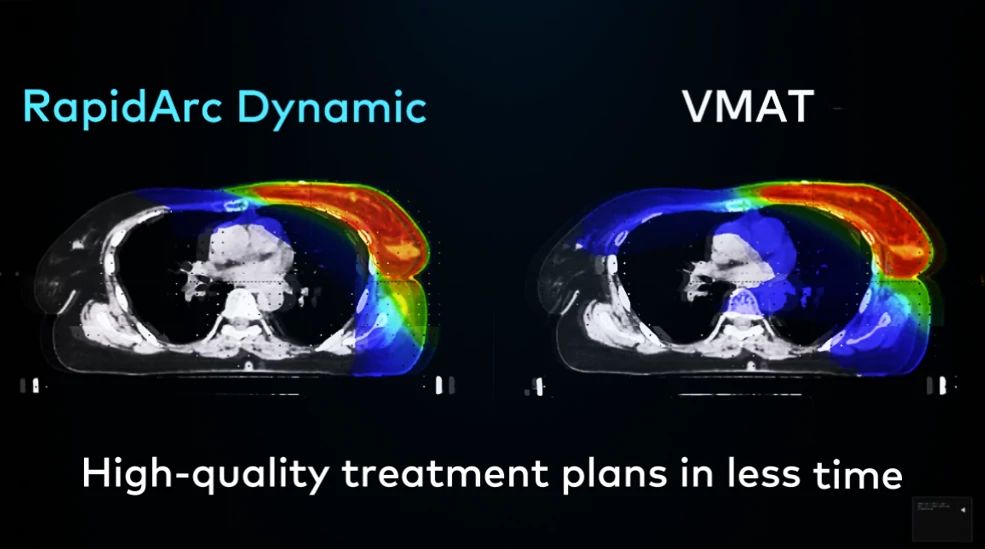
Archibald-Heeren also said his team found “significant reductions in organ doses are consistently observed in breast radiotherapy plans compared to previous VMAT techniques.”
“After reviewing initial breast plans using RapidArc Dynamic, I’m impressed by the consistent reduction in dose to surrounding organs, particularly the significant reduction to the heart, while maintaining excellent breast coverage.”
- John Boyages, MBBS, PhD, a radiation oncologist and breast cancer specialist for Icon Cancer Centre.
Dose modulation enables increased personalization, tailored treatment
RapidArc Dynamic represents an intelligent new direction in personalized arc therapy. Tailored to the specific needs of each patient, the solution enhances dose modulation capabilities and unlocks more functionality on the delivery system.
Clinicians can adjust the dynamic collimator in real time to help ensure radiation is delivered with high conformity, sparing healthy tissues. Modulated ports tailor dose distribution to each patient’s anatomy, enhancing treatment effectiveness.
Early cases showed RapidArc Dynamic provided statistically significant improvements in OAR sparing over VMAT, and decreased mean heart dose by 22%.
“After reviewing initial breast plans using RapidArc Dynamic, I’m impressed by the consistent reduction in dose to surrounding organs, particularly the significant reduction to the heart, while maintaining excellent breast coverage,” said John Boyages, MBBS, PhD, a radiation oncologist and breast cancer specialist for Icon Cancer Centre.
Additionally, clinicians can automatically account for patient variability during optimization, helping ensure that even with patient movement or anatomical changes, the treatment remains effective and accurate.
Researchers Tuomas Koivumäki, PhD, and Topi Nykänen, from Hospital Nova of Central Finland, Wellbeing Services County of Central Finland, found the solution’s ASF feature facilitated breast planning by reducing manual steps, noting it “had a clinically comparable mean skin doses and PTV coverages to virtual bolus method. Paired with RapidArc Dynamic, it ensures consistent, efficient, and high-quality treatment plans.”
Hear more from our experts:
Webinar: Breaking Boundaries in Radiotherapy: The Power of RapidArc Dynamic with Expert Insights
Webinar: RapidArc Dynamic in Head & Neck Applications: Smarter, Faster and More Conformal
The statements by Varian's customers described here are based on results achieved in the customer's unique clinical setting. Because there is no "typical" clinical setting and many variables exist, there is no guarantee that other customers will achieve the same results.
- May Abdel-Wahab et al., Global Radiotherapy: Current Status and Future Directions—White Paper. JCO Glob Oncol 7, 827-842(2021).DOI:10.1200/GO.21.00029
- Jaffray DA, Knaul F, Baumann M, Gospodarowicz M. Harnessing progress in radiotherapy for global cancer control. Nat Cancer. 2023 Sep;4(9):1228-1238. doi: 10.1038/s43018-023-00619-7. Epub 2023 Sep 25. PMID: 37749355.
- Darby SC, Ewertz M, McGale P, Bennet AM, Blom-Goldman U, Brønnum D, Correa C, Cutter D, Gagliardi G, Gigante B, Jensen MB, Nisbet A, Peto R, Rahimi K, Taylor C, Hall P. Risk of ischemic heart disease in women after radiotherapy for breast cancer. N Engl J Med. 2013 Mar 14;368(11):987-98. doi: 10.1056/NEJMoa1209825. PMID: 23484825.
- Atkins KM, Chaunzwa TL, Lamba N, et al. Association of Left Anterior Descending Coronary Artery Radiation Dose With Major Adverse Cardiac Events and Mortality in Patients With Non–Small Cell Lung Cancer. JAMA Oncol. 2021;7(2):206–219. doi:10.1001/jamaoncol.2020.6332
- Atkins, K, Rawal, B, Chaunzwa, T. et al. Cardiac Radiation Dose, Cardiac Disease, and Mortality in Patients With Lung Cancer. JACC. 2019 Jun, 73 (23) 2976–2987. https://doi.org/10.1016/j.jacc.2019.03.500
- E. Hubley, B. Archibald-Heeren, T. Koivumäki, B. Baron, A. Billaudeau, E. Costa, A.S. Dirand, L. El Moudden, A.H. Josse, A. Kärnä, B. Koger, T. Nykanen, D. Peurien, V. Raatikainen, A. Veret, J. Vu-Bezin, Rethinking Breast Irradiation Using Volumetric Modulated Arc Therapy with the Integration of Static Angle Ports and Dynamic Collimator, International Journal of Radiation Oncology*Biology*Physics, Volume 120, Issue 2, Supplement, 2024, Page S217, ISSN 0360-3016, https://doi.org/10.1016/j.ijrobp.2024.07.2297.
- E. Hubley, B. Koger, M. Salerno, R.M. Scheuermann, T. Li, L. Dong, K. Teo, Characterization of a Treatment Plan Optimization Algorithm for VMAT with Integrated Static-Angle Ports, International Journal of Radiation Oncology*Biology*Physics, Volume 120, Issue 2, Supplement, 2024, Page e139, ISSN 0360-3016, https://doi.org/10.1016/j.ijrobp.2024.07.2089.
- E. Hubley, B. Archibald-Heeren, T. Koivumäki, B. Baron, A. Billaudeau, E. Costa, A.S. Dirand, L. El Moudden, A.H. Josse, A. Kärnä, B. Koger, T. Nykanen, D. Peurien, V. Raatikainen, A. Veret, J. Vu-Bezin, Rethinking Breast Irradiation Using Volumetric Modulated Arc Therapy with the Integration of Static Angle Ports and Dynamic Collimator, International Journal of Radiation Oncology*Biology*Physics, Volume 120, Issue 2, Supplement, 2024, Page S217, ISSN 0360-3016, https://doi.org/10.1016/j.ijrobp.2024.07.2297.